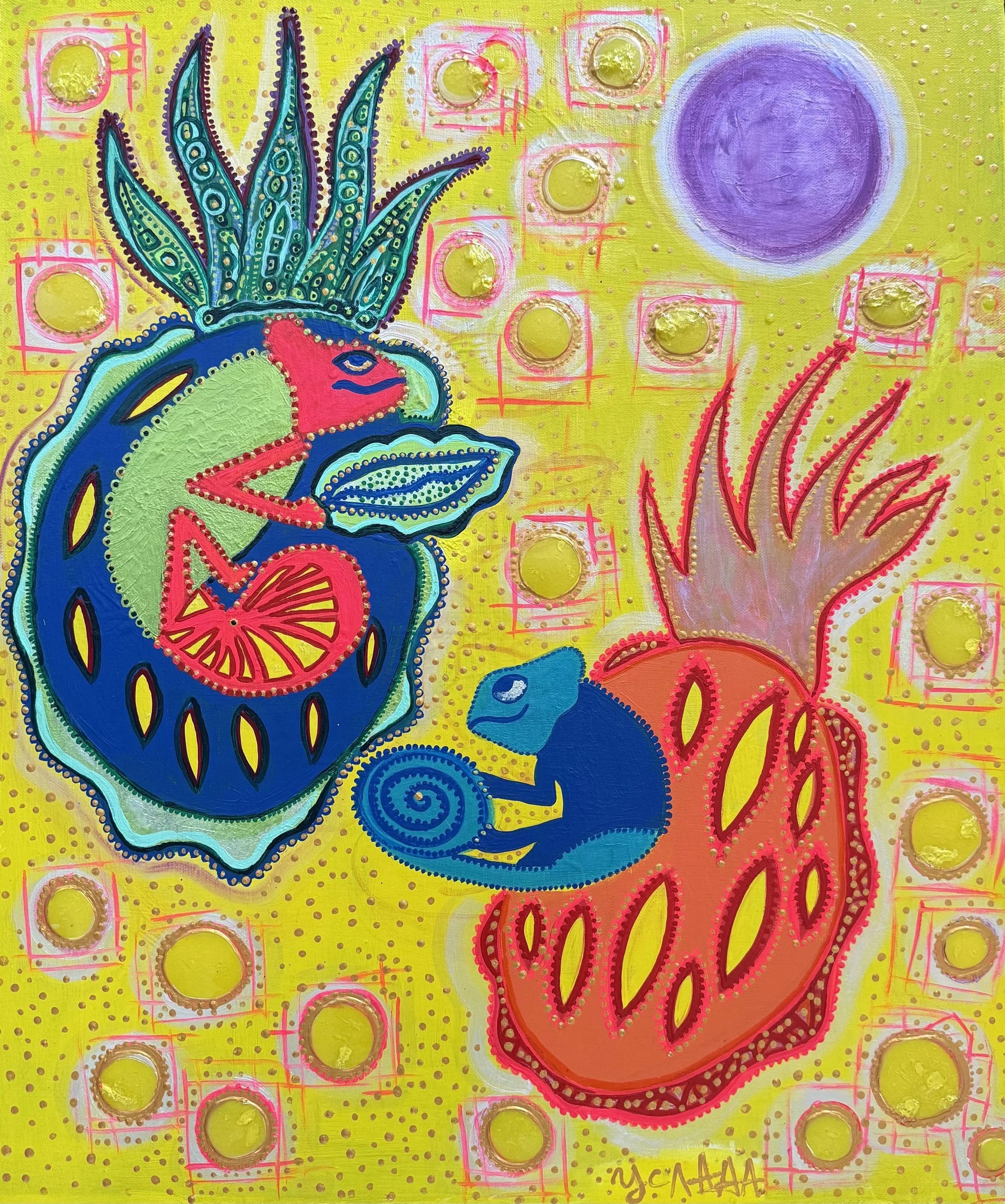
The Dharma Darling
Most of us, at some point, stop in the middle of our lives and ask: what if something larger is hidden inside me — a potential I don't yet know, but which, once entered, would let me create wonders no one else could make? That's the state we reach for on some subconscious level, but which only a few of us ever attain.
The key to it isn't in material goals. It's an inner state: ecstasy paired with total peace, full acceptance of oneself as a divine design, delight in every minute of our visit to Earth. This is the path of dharma. The word is Sanskrit, from a root meaning "to hold" or "to support": the order that holds a life together, and in the Indian traditions, svadharma, the calling that's uniquely yours. It belongs to us and to no one else, and almost no one reaches it without first going through loss, through difficulties that make the soul contract. Pain, more often than not, isn't a direct response to what's happening around us — it's an inherited inner state, a veil that's traveled with us since birth, filtering how we see the world even when nothing around us is objectively tragic.
A few years ago, in the middle of a very intense excavation of my own psyche, I heard, in meditation, a phrase: The Dharma Darling. I knew immediately I'd heard the name of something I had to make.
This spring I began a series of 44 paintings under that title. This project is about resilience, about living one's dharma after overcoming obstacles and difficulty. Each painting is built from archetypes and symbols that carry a life lesson, a symbolic situation that draws the viewer into a dense field of imagery — a philosophy grounded in my own visual language, Imaginal Symbolism. Each canvas marks a step on the hero's path: not a punishment from the universe, but a lesson met with gratitude, carrying us forward into a renewed consciousness.
I've worked this way by instinct since 2011, letting archetypal figures surface, usually in meditation, and putting them directly onto canvas. I didn't have a name for it until 2024, during an exhibition, when I came across philosopher Henry Corbin's concept of the mundus imaginalis — the imaginal realm as a real order of being, not metaphor or fantasy. His vocabulary described, with unsettling precision, the place I'd already been painting from for over a decade. The Dharma Darling series is where that language does its most direct work: each painting is a threshold into that realm, built from recurring figures — the golden woman, the pomegranate, insects and birds, exotic plants, rivers, oceans and celestial bodies — that carry meaning the way symbols do in Byzantine icons or medieval illuminated manuscripts, not illustrating an idea but enacting it.
Many people look at my paintings and see only joy, only light. But the real path to happiness almost always runs through the darker rooms of the soul — the places we're afraid to touch, hard to admit to ourselves. Every painting in the series is a kind of alchemy: a passage from darkness into light. The color here isn't decoration, it's a joy earned through self-knowledge — the passage from rich, heavy mud to the lotus that could never bloom in its full, royal beauty without having passed through that mud first.
Making each painting is demanding work, emotionally, for me too. I can't work on several canvases at once — each asks for full immersion in the theme I have to live through first. It's a continuation of what I often call my dance with the Divine, which is where this work has always come from, long before I had Corbin's words for it. I've gone deep enough into this process that I haven't been keeping pace with it on social media.
For anyone who wants to witness this path, I invite you to subscribe to my mailing list. There's no fixed schedule — only my Muse knows when each piece is ready — but I'll share the process as it unfolds: the finished paintings, and the notes behind them. You'll be the first to know as this series takes shape.
Be there when the next painting is finished
A letter goes out each time a new painting is born: the finished canvas, notes from the making, and the diary fragments behind it. There's no schedule, because the paintings don't keep one.